Fall Into Great Health: Stress, Sleep and Focus When School Season Starts
Sep 29, 2026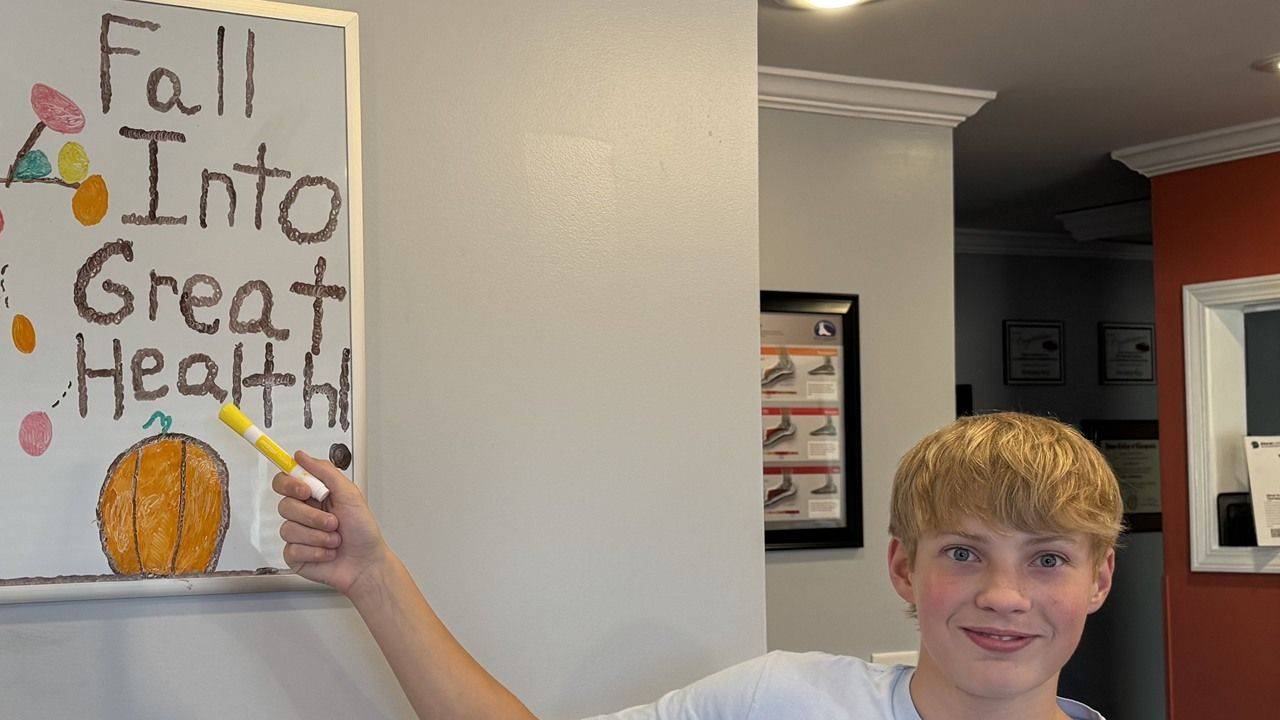
My son gave the board at our front desk its fall makeover this month. Leaves, a pumpkin, and four words in brown marker that everybody walking in has been reading all week.
Fall Into Great Health.
I have walked past it about forty times now and I keep catching on the same word.
Fall.
Nobody falls into great health. I have been doing this a long while and I have not seen it happen once.
Health gets built. It gets built the way a garden gets built, or a savings account, a little at a time, on purpose, on plenty of days when nobody feels like it.
So, happy fall y'all. Now let me tell you what I am actually thinking about this time of year.
September does something to a house
School started. The buses are running. Everybody in this office is on a different schedule than they were a month ago, and I would guess your house is too.
Somewhere around week four, this is what parents start describing to me.
Homework that should take twenty minutes is taking three hours. The teacher has sent a note home. Grades that were fine in the spring are not fine now. And the same child who cannot get going in the morning will not settle down at night.
The bedtime part is usually what wears a family out fastest, because it lands at the hour when everybody is already spent.
Watch what stress does to a body, because you can see it
A person under pressure braces. The shoulders come up. The jaw sets. The stomach goes tight. That is a protective response, and it is supposed to happen. A nervous system that senses a demand gets the body ready to meet it.
The trouble starts when it does not switch back off.
A child who carries that home from school at three o'clock is often still carrying it at nine. You can watch them lie down with it. A body that is still braced does not drop off to sleep easily, and a child who slept poorly is a child with less to work with the next morning. The next morning goes badly, which is one more demand, and around it goes.
Parents rarely describe that as a loop. They say "he just cannot focus" and "she will not go to sleep," usually on the same phone call, with no idea those two sentences are about the same week.
Now the careful part
Nothing I just described names a cause.
Trouble with attention is an experience, and experiences do not tell you where they came from. Sleep, stress, mood, nutrition, vision, hearing, a learning difference, a medical condition, a hard year at home. Every one of those arrives in a household as the same complaint, which is a kid who cannot focus.
So if this is going on at your house, start with your child's doctor. I mean that plainly. Several things look exactly like this and get missed, and most of them are very workable once somebody identifies them. Snoring and disrupted sleep. Iron and thyroid. Vision and hearing nobody has checked since kindergarten. Anxiety. A learning difference that has nothing to do with effort.
A concern that keeps coming back deserves a real evaluation, and I am not the first stop for that.
On medication, since it is probably in the room
If your pediatrician has raised medication, that conversation belongs between you, your child and the prescriber. Those medications help a great many children and I am not here to argue with anybody's prescription. Nobody should start, stop or change one because of something they read on a blog, including this one.
One piece of guidance is worth knowing, because plenty of parents have never been told it. For children under six, the CDC recommends behavior therapy first for ADHD, specifically parent training in behavior management, before medication is tried. That is guidance about the order things are attempted in, and it comes from the CDC.
The gears
This is how I explain what we do.
A car does not drive in one gear. You need a different one to pull out of the driveway than you need out on 19E, and the whole purpose of a transmission is being able to change. A brain works along the same lines. There is a gear for bearing down on a worksheet, a gear for settling at night, a gear for recovering after a hard day.
There is no single best gear. Nobody is supposed to be calm all day or locked in all day. What matters is whether the brain can reach the gear the moment calls for, hold it while it is needed, and then leave it again.
Difficulty shows up as being stuck. Too wound up to sleep. Too scattered to read a page. Still fired up an hour after practice ended.
That is an analogy and it is never a diagnosis. Nobody's brain is literally stuck in a gear.
What we actually look at
Before we train anything, we map it, with a qEEG, a quantitative EEG. Sensors sit on the scalp and read electrical activity. Nothing is sent into the brain. The sensors only read.
I describe it like a forest. One tree talks to another tree. Groups of trees talk to groups of trees. And the whole forest talks to itself. The map measures how those conversations are going, and shows where the patterns sit against normal ranges, high and low.
What a brain map does not do is diagnose anything. It cannot point at a color and name a disorder. It measures, it shows, and it lets us ask better questions about one specific child instead of a category.
And then the training
Neurofeedback is a form of biofeedback. Brain activity is recorded, and feedback comes back through a movie, a sound or a game. When the brain produces a healthier pattern, the feedback rewards it. When it drifts, the feedback dims.
Your child does not have to figure anything out during a session. They do not need to know which brainwave they are producing. Repetition and reward do the work, the same way repetition and reward do the work with anything else a brain learns.
The word is training, and that word is carrying real weight in this sentence. This is training toward self-regulation. It sits alongside medical care. Plenty of people train while they are under a doctor's care, and that is the ordinary case rather than the exception.
It is also not right for everyone. Sometimes the map tells us so, which is one of the reasons we look first. Individual responses vary, and I cannot promise you an outcome. I would not trust anybody who did.
Back to the whiteboard
Great health gets built. So does a school year.
He is right about the season and I love that pumpkin. Falling is the one way this never happens. You build it, in the fall the same as every other time of year, in small repeated pieces on ordinary days when nothing feels like it is changing.
If the homework hour and the bedtime fight have been running long enough that you have started to dread both, your child's doctor is the first call. If you want to know what a brain map would show about your specific child, that is a conversation I am always glad to have.
See if you qualify. Start with the brain health assessment and we will go from there: braincoreofelizabethton.com/pages/brain-health-assessment
Or just call the office. 423.542.3337, or text 423.380.0877.
If you or your child are having thoughts of self-harm, or you are worried about someone who is, please call or text 988, the Suicide & Crisis Lifeline. It is free, confidential and available 24 hours a day. If someone is in immediate danger, call 911.
Please note: we will be closed October 22nd and 23rd. Dr. Dennis will be at a BrainCore neurofeedback symposium on Hilton Head Island, learning the latest settings so the training we run here is current. Call or text if you need to be seen that week and we will get you in before we leave or right after we get back.
Office Hours
Mon & Thu: 7:30am–Noon and 1:30–5pm
Tue & Fri: 7:30am–Noon
Wed: 8:30am–Noon and 2–6pm
Phone: 423.542.3337 | Text: 423.380.0877
Yours In Health,
Dr. Dennis & Your BrainCore of Elizabethton Team